Featured

Introduction

It was Alex’s first day of college.

He/she made some friends, a handful even going to the same college. There were a few failed tests along the way, some clubs joined and dropped. Alex had a wild, but fun high school life.

The school seems to be more vibrant, especially with the guys with their hair worn longer and girls wearing pretty dresses; much different from the more strict and proper high school and elementary.

The first class opens up with the usual introductions: name, high school, what you like. Alex couldn’t help but judge the new classmate wearing the tank top and short skirt as she bubbly introduces herself as “Chloey”. The girls around her giggled and whispered among each other as soon as she finishes.

“Definitely a popular kid,” Alex automatically thought as the next person was called.

The cognitive bias of Representativeness is evident here. We can’t help but stereotype people based on what we already know from their similar characteristics to a certain group. This is not necessarily bad, as it allows people to know generally how to approach certain types of people. 

Soon, Alex had to make an introductory note: Alex Dela Cruz, Philippine Science High School, likes reading fiction stories.

There were a few mutters of the words synonymous to “smart” which Alex was used to. The rest of the time was a breeze and it just so happened that teacher would like everyone to interact more, so everyone had to pair up. There were a few sighs. Why are we still doing this in college?

Everyone was quick to grab the person closest to them. Alex looked around quickly and found that the closest non-paired people were a girl and guy. Alex has to choose either one of them.

System 1 is in play as there is no time to form a concrete, detailed thought and it just works on first impression. Choose for yourself.
The nice looking girl with a ponytail.

The guy who’s frowning.

Featured

Alter Ego

Entry #2

Image from https://theshininggem.wordpress.com/2017/07/09/globalization-and-jingoism-always-coexist/

The growth of technology has continually allowed people to connect with others more than ever. There is the increase of use of telephones of the 2000s to social media platforms where everyone is capable of sharing about anything from stories to art. This is well beyond the days of Web 1.0, where only professionals could post. We have entered a new era of Web 2.0, where anyone is capable of connecting with others through the internet. Aside from the online exchange, you could physically go to another country. Through these experiences, there is an exchange of ideas, products, beliefs. This is globalization (Hermans, 2015).

Globalization gives us a perspective on the world. It’s counterpart, localization, refers to what has already been there since childhood. However, with the mixing of different cultures and lifestyles, there may be the development of an identity crisis. Globalization is Janus-faced, wherein it could be both a bringer of innovation but also marginalization (Hermans, 2015).

If we are careful to balance our local and global identities, it is possible to fuse these two identities into a hybrid form. This hybrid form is not necessarily the same as the original two, and instead may take a new form, an “alter ego”.

Our presentation

My slide of our presentation
Image from https://www.pinterest.co.uk/pin/491033165602350555/

On the first day of February, the class was given time to share their global, local, and hybrid identity. This was in lieu of what we had learned regarding globalization.

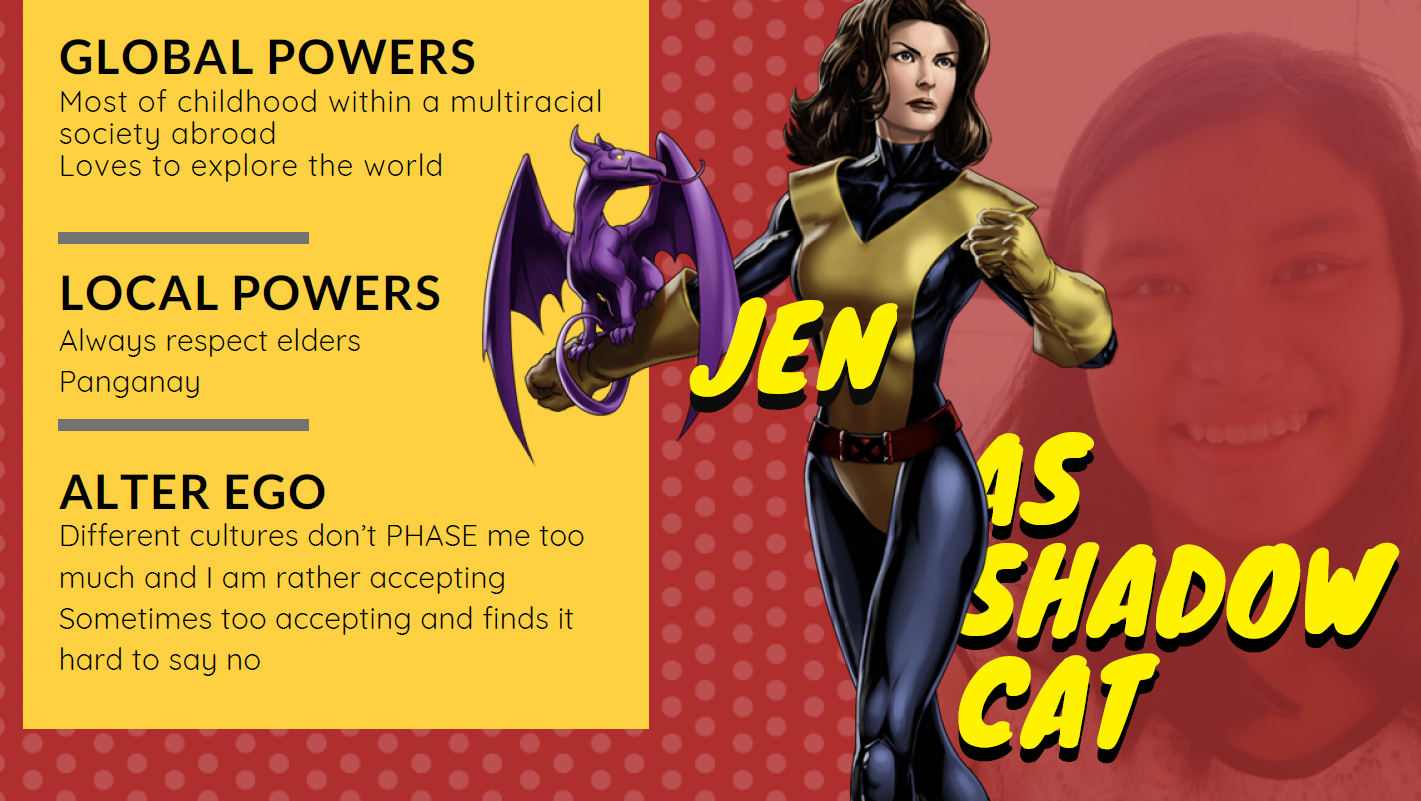
My group opted to use X-men as a metaphor for ourselves; each character has a unique set of powers. Global and local “powers” for many of us group members may intersect one way or another because of similar backgrounds.

For me, my global identity is someone who loves travel and exploration. On the other hand, my local identity lies in being respectful towards elders and being the “panganay” (first-born child). The panganay usually has the value of responsibility.

Shadow Cat is not a well known X-men member, but nonetheless is still doing her part. Her power is to phase through matter, and I used it as a pun in my presentation saying how differences don’t “phase” (faze) me and I am accepting and respectful of different beliefs, cultures and the like; particularly because I grew up Singapore. As from my presentation, I did say like globalization as a whole, it may be Janus-faced. I may be too accepting of differences that I forget what exactly is comfortable.

Globalization is something that we cannot stop against. For me, it great thing that can help the world progress forward. As an aspiring scientist, I believe globalization will aid greatly in the movement of science. Not only will the internet be able to share different researches, it is also a great medium to bring science to the common folk. But I am not denying that globalization has its own setbacks. There is the rise of racism and fake news online, poisoning international views. We should learn and teach others how to be careful so that the pros outweigh the cons.

Sources

Hermans, H. (2015). Human development in today’s globalizing world: Implications
for self and identity. In L. Jensen (Ed.), The Oxford Handbook of Human
Development and Culture: An Interdisciplinary Perspective (Ch. 3, pp. 28-42). New
York, NY: Oxford University Press.

Experience – BINHI output

My Life

There are many things that build “Jenica”: Country, Family, School life, Religion. These are not completely unique to me, but the specific experiences are the ones that make up the girl I am today.

For 12 years, I had lived in Singapore with my family and usually only visited the Philippines for a vacation and to spend time with relatives. I grew up to be a respectable, quiet girl. Eventually, we returned to the Philippines and I continued my studies in high school. In a way, I was able to experience both the foreign culture and local cultures.

Currently, I live out my life in a middle-class family as a student of the Ateneo. My father still works in Singapore as an OFW, and in his stead, my aunts take care of me. I am quite average in my academics, but I strive hard to develop myself in many aspects such as volunteer work for big events. I have been quite blessed with my upbringing and I really consider myself lucky, given so many opportunities. As such, Ateneo provided students with a new kind of chance through BINHI to get a glimpse into a different kind of life.

BINHI Experience

In my BINHI, we were able to enjoy time with a host family in GK Central. Me and Isaac, my partner, were under the care of Ma’am Emma as well as another group where we spent most of our time in. To help out, us students volunteered to chop the vegetables for the pancit canton cooked for everyone. It didn’t take long, and for the rest of my stay I was able to witness and join in on how the mothers would interact with each other, with us students, and with their children.

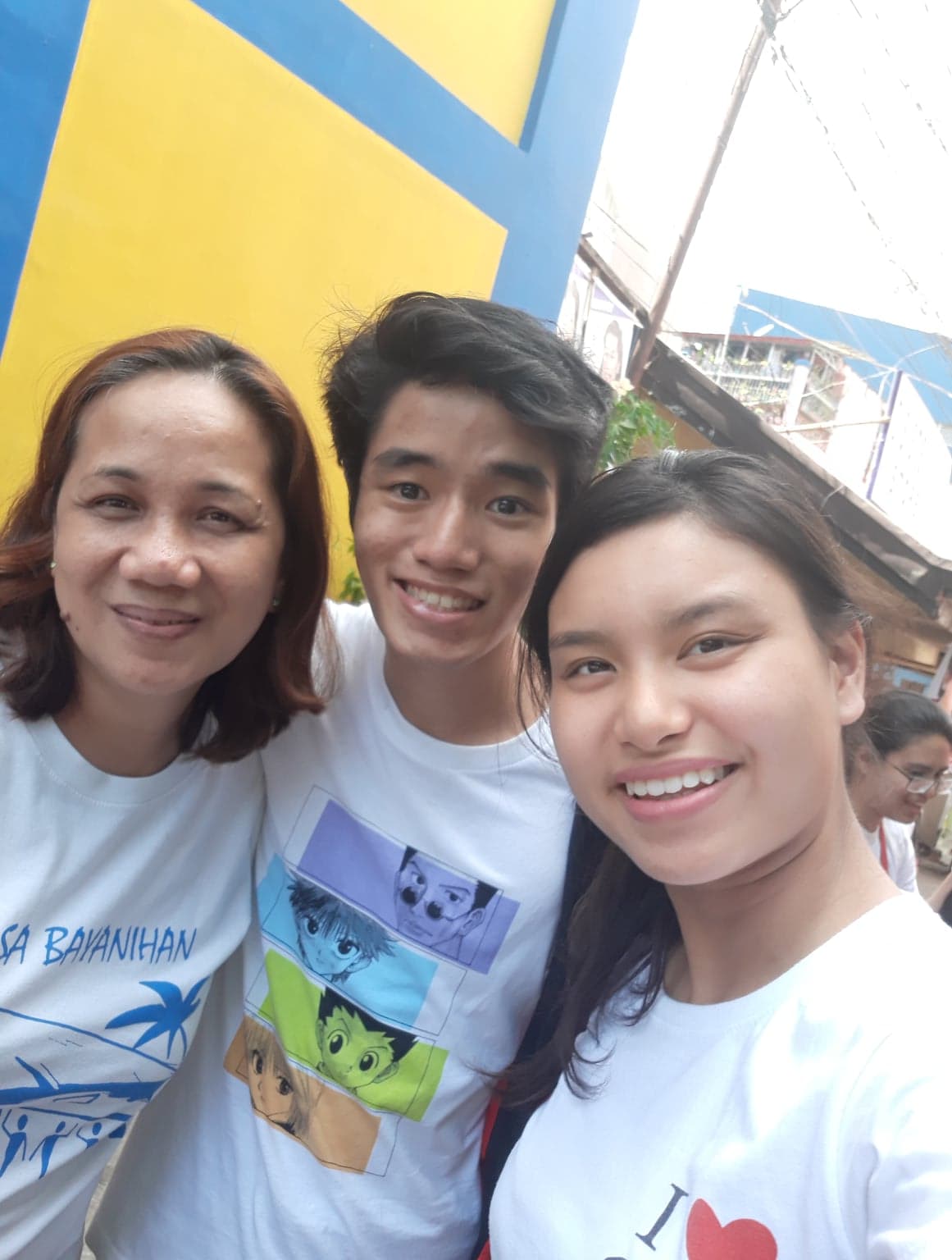
Selfie with Isaac and Ma’am Emma at the end of the experience

Despite being in the place for the first time, the atmosphere was something familiar. It very much reminded me of the times I would visit my relatives when I was younger. Their houses had the same feel as my relatives’ homes. When put it in another way, it was like of my own home with my two young cousins running about the house, my Titas scolding them, and later turning to me to talk about something.

There’s no denying that there would moments of awkward silence because we didn’t know where to start. The differences in our lifestyles were there, especially since we were students coming from one of the top schools of the Philippines while the BINHI location was just a humble abode. But through pakikiramdaman, conversations would start and carry on.

Through our interactions, I learned that Ma’am Emma’s husband works overseas as a baker. Furthermore, both me and another host mother come from the same religion (Iglesia Ni Cristo), so we were able to share some of our roles within it. Despite coming from different backgrounds, we had some overlapping traits. Other students were also able to share their own experiences and garner everyone’s attention. Aside from the kwentuhan, one of the members of the other group got to spend most of her time with one of the children and play with her.

Although our habitus are different, it is not an indication that we will not be able to make good company. Many of us were able to interact well during BINHI and I think given more time, we would be able to get along more. There are shared experiences which are important, as they are where the kwentuhan starts.

Between “you” and”me”

Sex is not really a complicated thing, but culture may make it difficult to talk about. However, as a Filipino woman, society expects me not to talk about it since nakakahiya siya.  I honestly have no problem talking about sex, especially from a biological standpoint. But as from the lessons, anything with the word “sex” is considered a “taboo”, even if you are not explicitly talking about sex itself.

I grew up in a family who holds these typical Filipino views regarding relationships and sex. I may align with some of these Filipino outlooks when it comes to romance and sex, however I do not condemn others’ opinion.

So I do understand where these terms related to relationships such as nahulog na rin ang loob (inner self “falls”), pakikiramdam (feeling each other’s feelings), and tamang edad (right age) because these may be used in conversations. Usually when the topic of love is brought up, a lot of my relatives usually say how I am young and beautiful, so it’s best to wait for the “right time” for the “right kind” of guy who will ask me out and eventually marry me.

At the same time, I understand if people go out of what is expected from them. If people want to have sex, they can, although I would encourage them to do it safely. I do admit that Philippines has a rather conservative point of view and I myself have “broken” some rules set by my family.

In the past, instead of the man initiating everything, I was the one who told him first and eventually we did end up together. It was a secret relationship and I was kind of disturbed at the mention of where there was “aversion to PDA” due to fear of disclosure because I was in that position. My parents would not approve of this relationship at all since it was not of the “right time” and without me telling them.

I now really understand how much verbal communication is important in relationships. Not only between partners, but also families. Keeping it between “you” and “me” is rather difficult without the support of people so close to both of us, so it’s much better being honest with them. At the end of the lesson, it is mentioned that cisgendered people are privileged, since they do not have to “admit” that they are so. I am glad I have one less obstacle to worry about, but for anyone else who does: don’tworry, you’ll be able to overcome that.

Social plot

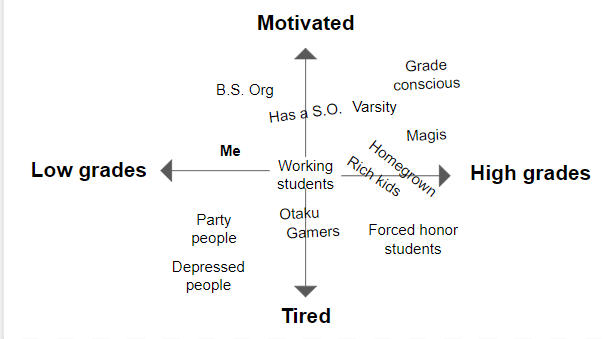
Social plots are comprised of crowds of an environment such as school. Crowds are usually based on a particular attributes that the members share in common. For example, varsity players are known to be competitive, and those of sports varsities, they are athletic. This concept is not very specific and tends to generalize people, however is good as a basis for establishing relationships.

My Social Plot of Ateneo. There are certain terms that really apply to Ateneo only.

Currently, my grades aren’t great but I’m trying my best to make them better. The crowd that I’m not remotely close to are the “Party People”, since I never really like big, drinking parties which college students typically have. Every other group nearby can be applicable, especially “B.S. Org”.

Peering through a window

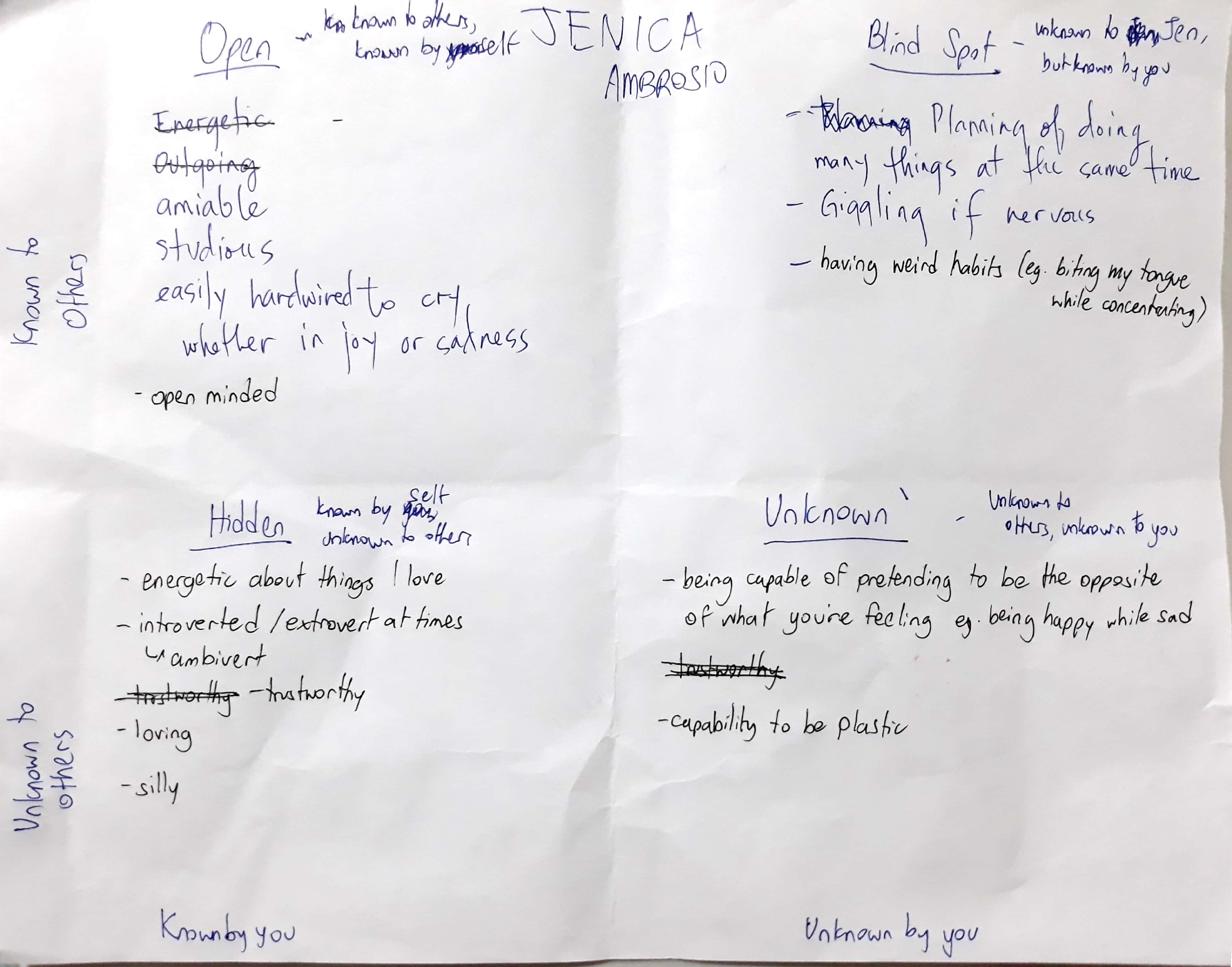
Johari Window

Through the Johari Window, the traits of a person is further explored in relation to other people.

Jenica’s Johari Window

Unfortunately, I was absent during the time this was done in class. The above Johari window was made at home, where I asked my aunt (my guardian) to write down traits about me in less than a minute. The following writings done in black pen were by me.

It was delightful to hear that my aunt looked at me mostly on a positive light and described me with adjectives such as amiable and studious. She did me honest notes certain characteristics such as myself being a crybaby and trying to multitask often. These were not wrong, thus I did not cross it out. However, I did cross out mostly the extrovert features my aunt believed I possessed. I couldn’t really agree fully on some points because it only applies to certain people such as family and close friends.

The Johari Window changes according to how much the peers writing were able to know you. My aunt knows me pretty well, and I tend to open up more to her compared to my classmates. Through this activity, I was reminded of how much my personality was different depending on the people I am around. I tend to huddle with a small group of friends, but I think they would say something similar since I treat them like family.

Self

I tend to have differing attitudes because of past experiences with certain groups of people. I tend to be quieter when with my choir member group as I’m used to keeping a serious mood while in church. Similarly on the opposite side, I’m chatty when I’m with my close friends or family. In the end, it is all my choice to act how I want.

Source

https://www.communicationtheory.org/the-johari-window-model/

Experiences

Entry #4

Guide Questions

1. What insights did you gain, if any, from learning about how your parents/guardians were raised?
2. Among Erikson’s stages of psychosocial development, which stage does your “most memorable story” seem to fall under?
3. What insights, if any, does this give you about your own, personal development?

Her story

My aunt, my mother’s sister, did not grow up within a rich family. They were not completely poor, but they lived a simple life. Her whole family worked hard just to make sure that all four daughters finished their education so to have a better life

In my younger years, I would have the luxury of time to do hobbies I loved while she would have to go home immediately to help out at the tindahan. Her mother was tough, not allowing any of her daughters to slack off and skip out on helping out with the tindahan or there would be a good whacking later. Coupled with interactions with strangers through the tindahan, her environment allowed her to grow up to a strong, sensible woman.

My story

Before now, I didn’t really interact with my aunt as much as I lived in Singapore. I would still meet her occasionally when both our families visited the Philippines, and there she experienced my antics. The most memorable thing I did when my aunt was around was when I was toddler.

One time, I was told to sit on the sofa and not leave my spot. I quickly obeyed, jumping into position and sat quietly. But just a few seconds later, especially once the adults were not paying attention, my younger self ran around the living room again. My aunt found it funny.

As according to Erik Erikson, the preschool-age is when children start to develop their sense of purpose, responsibility, and self-regulation. My aunt didn’t really scold me then and even found it amusing till this day, showing a more positive mindset regarding the matter.

Although this is not a good example of myself developing the positive outcomes of psychosocial development immediately, it shows how much I’ve grown up from not being able to sit quietly for a minute to be able to pay attention to a full hour lecture. I do note that the way I was raised was more closed than of my aunt’s, especially since I was the first-born child that my parents had doted over. Eventually, my mother, like my grandmother, made sure I worked hard and did not let me go to slack.

Others may be affected by negative experiences in their childhood and as a result, neglect their own children as well. Fortunately, I was blessed with a good family who cared a lot for each other and thus was raised well.

Boy with a frown

Alex reached over to the boy and tap his arm to catch his attention. He stopped looking around and quickly turned to Alex.

“Hey, have you partnered up with anyone?” Alex asked.

His frown dug deeper, although it was obvious by this point that he was confused.

“No? I guess you want to be ‘partners’?”

By partnering up with him, you have overcome the cognitive bias of the Halo effect (“what is beautiful is good”).

It turned out that the guy had accidentally fallen asleep during part of the introduction. Despite his initial disheveled appearance, he is friendly and apparently likes anime too.

“So what do you think about Kimi No Nawa when you watched it?”

“It sucks, too cliche.”

“I’m not into romance but it the graphics were cool.”

Wrong answer

Alex’s partner’s eyes lose a bit of sparkle.

“I see,” the partner said hesitatingly.

Even as they both try to talk, their conversation dies and they’re left to your own devices (literally) as the teacher takes their own sweet time. The teacher then calls out to change partners and this continues for the rest of the period.

That first impression didn’t stick well to Alex’s first partner and you never really got close to them. There may be more fish in the sea, however that could have been a good moment to gain a friend.

The end.

Maybe you should have been more careful with what you say to avoid the False-consensus Effect. Not everyone necessarily  agrees with what you say.

Try again?

Interesting take

The partner smiled at Alex.

“Straight to the point are we?” they said with a small smile.

The teacher eventually calls out for everyone to switch partners. The partners greet each other goodbyes.

“Nice knowing you, Alex. Let’s talk more later.”

And indeed did you talk later on. Somehow, that short conversation grew into something bigger. Now the first individual interaction has become a trusted friend.

The end.

Thanks to being careful of your words, thus eliminating cognitive bias; and because of that, Alex made a friend!